
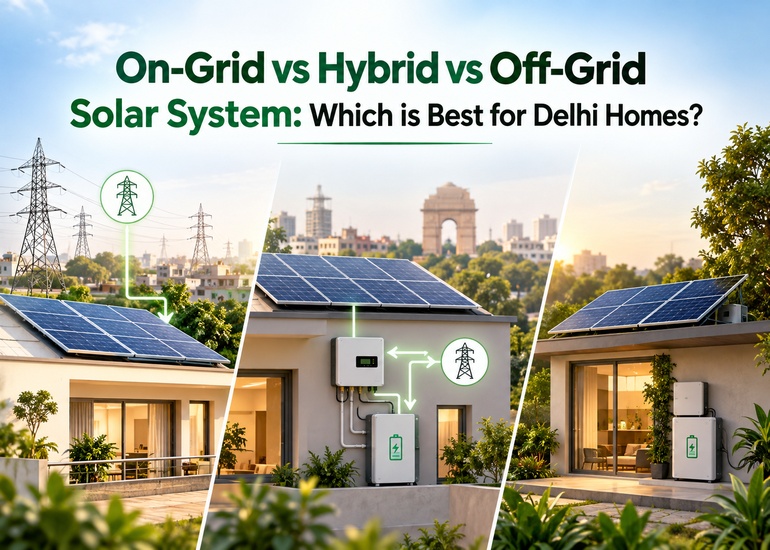
On-Grid vs Hybrid vs Off-Grid Solar System: Which is Best for Delhi Homes?
With rising electricity costs and increasing awareness about renewable energy, more homeowners are switching to solar power. However, choosing the right type of solar system can be confusing. The biggest question many homeowners ask is whether an on-grid, hybrid, or off-grid solar system is the best choice. The answer depends on your electricity consumption, budget, and power backup needs.
Delhi receives abundant sunlight throughout the year, making it an excellent location for solar energy. Before investing in a system, understanding how each option works can help you make a smarter decision. This guide compares all three solar systems, their advantages, limitations, and the situations where each performs best.
Understanding the Three Types of Solar Systems
1. On-Grid Solar System
An on-grid solar system is connected directly to the electricity grid. It generates electricity during the day, and any excess power can be exported through net metering. When solar production is low, electricity is automatically drawn from the grid.
Best for:
• Homes with reliable electricity supply
• Lower electricity bills
• Families looking for faster return on investment
Advantages
• Lower installation cost
• Net metering benefits
• Minimal maintenance
• High energy efficiency
Limitations
• Does not provide backup during power outages unless paired with battery storage.
2. Hybrid Solar System
A hybrid solar system combines the benefits of an on-grid system with battery storage. It stores excess electricity for later use while remaining connected to the utility grid.
Best for:
• Homes experiencing occasional power cuts
• Families needing uninterrupted electricity
• Homeowners seeking greater energy independence
Advantages
• Backup during outages
• Better use of generated solar energy
• Reduced dependence on the grid
• Flexible energy management
Limitations
• Higher installation cost because of batteries
• Batteries require periodic replacement over time
3. Off-Grid Solar System
An off-grid solar system operates independently without any connection to the electricity grid. It relies entirely on solar panels and battery storage.
Best for:
• Remote properties
• Farmhouses
• Areas with limited or no grid connectivity
Advantages
• Complete energy independence
• No dependence on electricity providers
• Reliable in remote locations
Limitations
• Highest installation cost
• Larger battery bank required
• More maintenance compared to other systems
On-Grid vs Hybrid vs Off-Grid: Quick Comparison
| Feature | On-Grid | Hybrid | Off-Grid |
|---|---|---|---|
| Grid Connection | Yes | Yes | No |
| Battery Required | No | Yes | Yes |
| Backup During Outage | No | Yes | Yes |
| Installation Cost | Low | Medium to High | High |
| Net Metering | Yes | Yes | No |
| Maintenance | Low | Moderate | Moderate to High |
Which Solar System is Best for Delhi Homes?
For most urban homes in Delhi, an on-grid solar system is the most practical choice because the city has a stable electricity network and offers net metering benefits. It provides excellent savings with a relatively low investment.
A hybrid solar system is ideal for families who cannot afford interruptions during power cuts. Although the initial investment is higher, battery backup ensures continuous electricity for essential appliances.
An off-grid solar system is generally recommended only for locations where grid connectivity is unavailable or unreliable. Most residential homes within Delhi usually do not require a completely independent setup.
Factors to Consider Before Choosing
Before selecting a solar system, evaluate:
• Your monthly electricity consumption
• Frequency of power outages
• Available rooftop space
• Budget for installation
• Future electricity requirements
• Local net metering policies
Choosing the right system after assessing these factors helps maximize savings and long-term performance.
Conclusion
There is no single solar solution that suits every household. An on-grid system is perfect for maximizing savings, a hybrid system offers the best balance between savings and backup, while an off-grid system provides complete energy independence for remote locations. Understanding your home's energy needs, budget, and local electricity conditions will help you make the right investment for years to come.
If you are planning to install a solar energy system, Solar India helps homeowners understand different solar solutions and choose an option that best matches their energy requirements while supporting a cleaner and more sustainable future.
FAQs
1. Which solar system is most suitable for homes in Delhi?
For most Delhi homes, an on-grid solar system is the best option because of reliable grid connectivity, net metering benefits, and lower installation costs.
2. Is a hybrid solar system worth the extra investment?
Yes. A hybrid system is valuable for households that experience regular power outages and need battery backup while still benefiting from grid connectivity.
3. Can an off-grid solar system power an entire house?
Yes. An off-grid system can power a complete home if it is properly designed with sufficient solar panels and battery storage to meet daily energy needs.
4. What is the biggest advantage of an on-grid solar system?
Its biggest advantage is reduced electricity bills through net metering, allowing homeowners to export surplus electricity to the utility grid.
5. How long do solar panels typically last?
Most high-quality solar panels have a lifespan of 25–30 years, with only gradual reductions in efficiency when maintained properly.